
Background
As women age, their ability to have children naturally decreases, especially after their mid-30s. For instance, while only 10% of women under 34 might have trouble conceiving naturally, this number increases to 87% for those over 45.
Although assisted reproductive technology (ART) such as in vitro fertilisation (IVF) aids conception, they’re less successful as women age, with those under 35 having around 41-43% chance of success compared to 1 to 2% for those over 441.
This happens because, with ageing, the quantity and quality of eggs in the ovaries decrease, and more abnormalities in the chromosomes occur, resulting in increased difficulty conceiving as well as increased risk of miscarriages, stillbirths and other birth issues compared to younger women.
What is Spermidine?
Spermidine is naturally found in various foods, particularly those that undergo fermentation or ripening processes.
Some spermidine-containing foods include:
- Soybeans
- Mature cheese like cheddar, gouda and parmesan
- Legumes such as lentils and peas
- Mushrooms, especially shiitake
- Wheat germ and fresh green pepper
The spermidine content in these foods can vary based on factors like ripeness, fermentation, and processing methods.
While these foods contain spermidine, the exact amount and how much our body can absorb is difficult to measure beacasue it can be influenced by various factors, including interaction with other nutrients and processing methods such as cooking2.
What was known?
Research on spermidine’s effects on extending lifespan in humans is still in its early stages.
The positive impact of spermidine on lifespan has been observed mainly in studies on mice and cell cultures, where it has been shown to:
- Enhance cellular health
- Promote autophagy (cell regeneration)
- Reduce age-related decline in certain functions, such as cognitive
- Improve cardiovascular health 3, 4
However, these findings have not been conclusively replicated in human trials.
Furthermore, the effect of spermidine on fertility had not been explored.
In a study recently published in Nature Ageing Journal in 2023, scientists Zhang and colleagues set out to investigate the role of spermidine in extending fertility span and improving egg quality in aged mice, pigs’ eggs and in vitro (laboratory test dishes).
What did they find?
First, the scientists compared differences in the composition of eggs between aged and younger mice by using methods that precisely separate and quantify each substance contained in the egg.
They found that the quantity of spermidine was substantially higher in younger mice compared to aged mice.
Secondly, they supplemented aged mice with spermidine injection in the abdominal area and analysed the effect of supplementation to check for:
- Egg maturation in aged mice. Typically, in aged mice and other species, including humans, there are eggs in the ovaries, however, they are not mature, hence no fertilisation takes place.
- They found that aged mice had less mature eggs compared to younger mice, however, aged mice supplemented with spermidine had a higher number of mature eggs compared to non-supplemented aged mice. This confirmed that spermidine potentially improves the quality of eggs as well as increases the fertility span of female mice.
- Follicle appearance (morphology). Follicles are like small sacs or bubbles in the ovaries that surround the eggs. By examining the size, shape, and characteristics of these bubbles, it is possible to understand how the eggs grow and mature. In aged mice and humans, there is a higher number of abnormal follicles than in younger mice and humans. They found that follicle appearance was improved in aged mice after supplementation with spermidine.
- Litter size: the number of pups delivered by mice in one gestation decreases as they age, and spermidine supplementation helped increase the number again, although not to the same extent as in younger mice. This measured fertility.
- The quality of eggs: they measured abnormalities in the chromosomes of eggs, which can impede conception or result in birth defects. They found that there was less probability of abnormalities in eggs of spermidine-supplemented aged mice through oral or injection methods compared to non-supplemented aged mice.
- They also looked at the number of cortical granules and mitochondrial function in supplemented aged mice compared to non-supplemented aged mice. Both processes are very important to improve the chances of conception.
- They concluded that both these functions were improved in supplemented aged mice compared to non-supplemented aged mice.
Spermidine improves fertility by activating mitophagy, enhancing mitochondrial function.
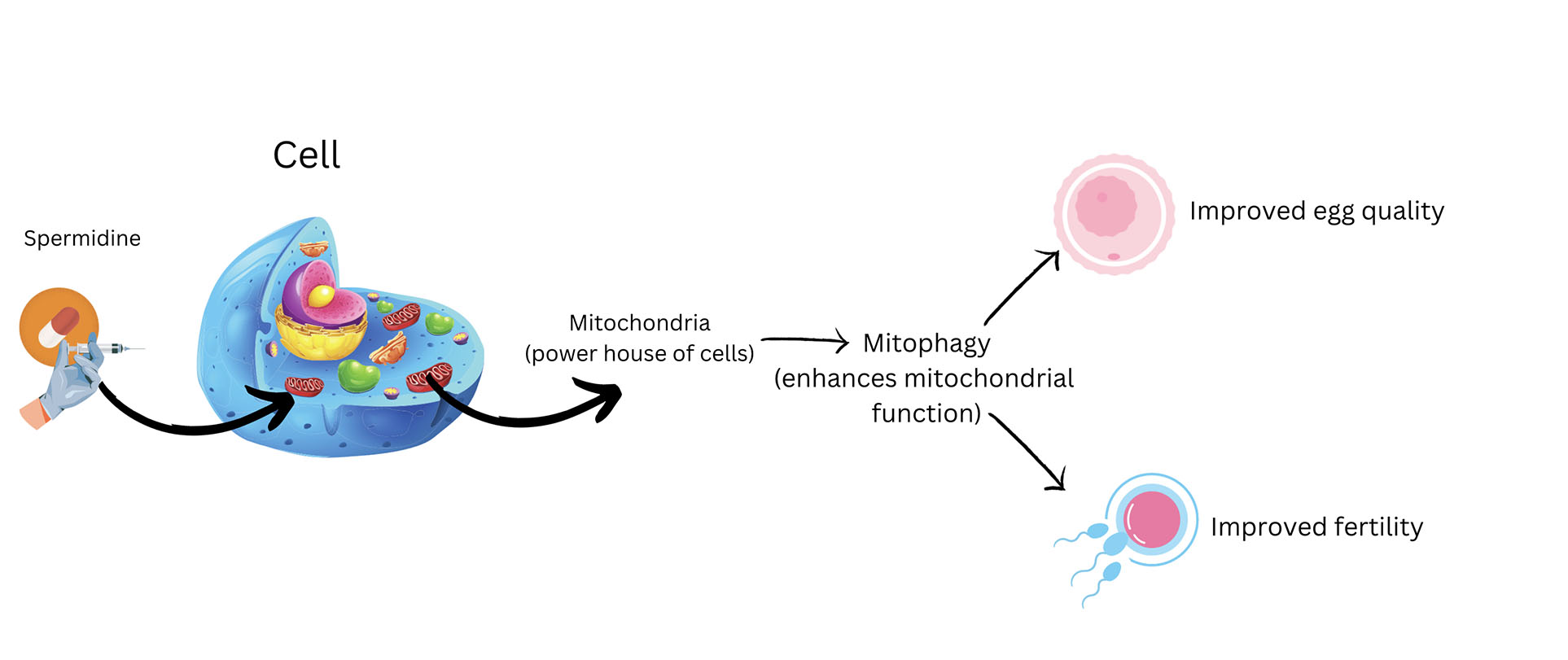
Image by whitespacenutrition
What else did they find?
Having confirmed spermidine’s role in maintaining fertility, scientists aimed to uncover how spermidine positively affects the health of eggs.
Previous studies linked spermidine’s ability to enhance longevity with its capacity to trigger autophagy.
Specifically, the targeted cleaning of faulty mitochondria, known as mitophagy, is crucial for sustaining functional mitochondria, which play a substantial role in the quality and health of eggs. In the first step of the analysis, they concluded that supplementation of spermidine restored the autophagy of cells in aged mice, more specifically, mitophagy, which optimised the function of cells through mitochondrial renovation.
To investigate if spermidine’s protective effects were associated with increased mitophagy activation, the researchers conducted another experiment.
They extracted eggs from aged mice and exposed them to spermidine, along with a mitophagy inhibitor.
This allowed them to determine if blocking mitophagy reduced spermidine’s impact on egg maturation.
They assessed egg maturation by measuring the percentage of first polar body extrusion, a key indicator of egg maturation. The results indicated that inhibiting mitophagy significantly hindered polar body extrusion in spermidine-treated aged mice.
This suggested that activating mitophagy is essential for spermidine to facilitate egg maturation.
In vitro tests and tests carried out in pig’s eggs also confirmed the positive results they found in mice.
Implications for women’s health
In summary, spermidine supplementation seems to have a positive influence on egg health by potentially supporting cellular maintenance processes, improving mitochondrial function, and possibly counteracting some age-related changes that impact egg quality. This can potentially aid in extending women’s reproductive years as well as enhance their chances of conceiving through ART.
However, further research is necessary to fully understand how spermidine specifically affects the health of eggs and its potential applications in fertility treatments or reproductive health in humans.
In an article by Science Media Centre (2023), PD Dr Verena Nordhoff, Head of the Reproductive Medicine Laboratory at the Centre for Reproductive Medicine and Andrology, said about the study:
“Overall, this is a very good and solid study. However, we must keep in mind that mice are very different from humans, especially in terms of the ageing process. A female mouse lives for about two years and is fertile for most of her life. In contrast, humans are long-lived and the decline in female fertility with age is associated with other complications, which are absent or maybe irrelevant in mice.” 5
References:
Original article: Zhang, Y. et al. (2023) Polyamine metabolite spermidine rejuvenates oocyte quality by enhancing mitophagy during female reproductive ageing. Nature ageing. [Online] 3 (11), 1372–1386
- Kim, H. O., Sung, N. & Song, I. O. Predictors of live birth and pregnancy success after in vitro fertilization in infertile women aged 40 and over.Clin. Exp. Reprod. Med. 44, 111–117 (2017).
- MILOVIC, V. (2001) Polyamines in the gut lumen : bioavailability and biodistribution. European journal of gastroenterology & hepatology. [Online] 13 (9), 1021–1025.
- Minois, N. (2014) Molecular Basis of the ‘Anti-Aging’’ Effect of Spermidine and Other Natural Polyamines – A Mini-Review’. Gerontology (Basel). [Online] 60 (4), 319–326. Hofer, S. J. et al. (2022) Mechanisms of spermidine-induced autophagy and geroprotection. Nature aging. [Online] 2 (12), 1112–1129.
- Murray-Stewart, T. (2019) Polyamine Metabolism in Disease and Polyamine-Targeted Therapies. MDPI – Multidisciplinary Digital Publishing Institute.
- Science Media Centre (2023 October 16). Expert reaction to study looking at spermidine supplementation and age-related fertility decline in mice.