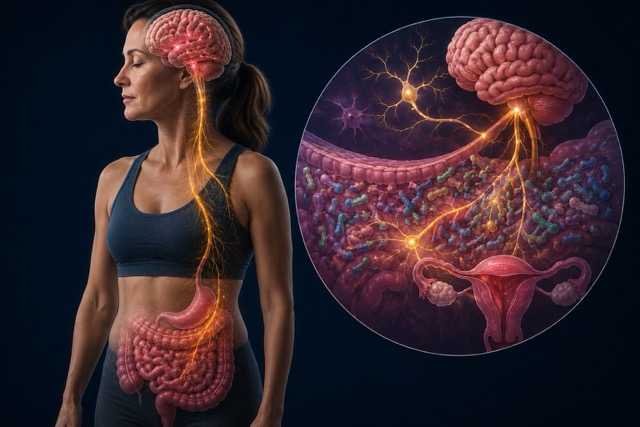
A science-based guide to nutrition for perimenopause, menopause, and the decades that follow.
Somewhere in your early forties, things start to feel different.
The same dinner that never used to bother you now leaves you bloated and sluggish. Your energy dips harder in the afternoon. Sleep becomes lighter, more fragmented. Weight settles around your middle in a way it never did before, even though, on paper, nothing about your routine has changed.
This isn’t in your head. What you’re experiencing is the most significant metabolic shift of a woman’s adult life.
Let’s talk about what is actually happening in your body in a way that is scientifically accurate but also practical.
This is the first in a series on the Three Systems of Compounding Health, the framework I use to help women over 40 build the kind of strength, energy, and clarity that lasts into their seventies, eighties, and beyond. We’re starting with metabolic health, because everything else builds on top of it.
What metabolic health actually means
Metabolic health is one of those phrases that gets used everywhere and defined almost nowhere. So let’s be precise.
Your metabolism is the sum of every chemical process your body uses to turn food into energy, build and repair tissue, and keep your systems running. Metabolic health is how well that machinery is working. The clinical markers are familiar ones: blood sugar regulation, insulin sensitivity, blood pressure, cholesterol and triglyceride levels, and where your body stores fat (particularly the visceral fat that sits around your organs).
When these markers drift in the wrong direction, you don’t necessarily feel it as illness. Instead, you feel it as fatigue. As stubborn weight gain. As a nagging sense that your body has stopped responding the way it used to.
For women, the years between roughly 40 and 55 are when this drift most often begins. And the reason is biological, not behavioural.
The oestrogen connection most women are never told about
Here is what every woman over 40 deserves to know: oestrogen is a metabolic hormone.
Most of us learned that oestrogen is the “fertility hormone”, important for periods, pregnancy, and not much else after that. However, the truth is far more interesting. Oestrogen quietly orchestrates much of your metabolic machinery. It enhances how well your cells respond to insulin, supports muscle maintenance, regulates where fat is stored, dampens inflammation, and helps protect your cardiovascular system.
When oestrogen begins to fluctuate in perimenopause and then declines through menopause, that protection lifts.
What the latest research shows
A 2022 ZOE PREDICT study of over a thousand women found that, even after accounting for age, post-menopausal women had higher fasting glucose, higher HbA1c, more inflammation, larger blood-sugar spikes after meals, and more glucose variability across the day than pre-menopausal women. In age-matched subgroups, comparing women of the same age, simply on different sides of menopause, the post-menopausal group still showed measurably worse glucose responses. Therefore, menopause itself, not just getting older, was driving the change.
Other research backs this up consistently. A 2024 meta-analysis of nineteen studies found that women who experience menopause earlier than the average age (45 years) have 24% higher odds of developing type 2 diabetes than women who reach menopause at the typical age. Furthermore, recent commentary in Nature Reviews Endocrinology has argued that midlife should count as a critical window for diabetes prevention in women, with menopause recognised as a sex-specific risk factor in its own right.
This is important because once you understand what is changing and why, you can do something about it.
The four shifts happening underneath the surface
In essence, four interrelated changes drive most of what women feel during this transition. Understanding them turns vague frustration into something you can actually work with.
1. Insulin sensitivity declines. Oestrogen normally helps your cells respond efficiently to insulin, the hormone that escorts glucose out of your bloodstream and into your tissues. As oestrogen falls, that responsiveness drops. The same meal your body once handled cleanly now produces a higher, longer blood-sugar spike, and over time, your pancreas has to work harder to compensate.
2. Where you store fat changes. Pre-menopause, women tend to store fat on the hips and thighs (subcutaneous fat, which is metabolically relatively benign). Post-menopause, however, fat shifts to the abdomen as visceral fat, the kind that wraps around the liver, pancreas, and intestines. Visceral fat behaves badly in all the wrong ways: it secretes inflammatory signals and worsens insulin resistance further. Studies show post-menopausal women accumulate abdominal fat at roughly twice the rate of pre-menopausal women, even when matched for age and calorie intake.
3. Muscle becomes harder to maintain. Muscle is your single most important metabolic organ, it does the heavy lifting of glucose uptake and burning. However, during the menopause transition, women experience a measurable decline in muscle mass, often alongside an increase in fat mass. To make matters more challenging, ageing muscle responds less to the protein and insulin signals that build it (a phenomenon researchers call anabolic resistance), meaning women in midlife need more protein and more of a stimulus from strength training to maintain what they have.
4. Stress and sleep amplify everything. Cortisol, your main stress hormone, also rises in midlife as the body adjusts to the loss of ovarian hormones. Elevated cortisol drives the liver to dump more glucose into the bloodstream, worsens insulin resistance, encourages visceral fat storage, and disrupts the sleep that would otherwise help you recover. As a result, it’s the loop that makes so many women feel “wired and tired” simultaneously.
These four shifts feed each other. Lower oestrogen drives insulin resistance, which drives visceral fat, which drives more inflammation, which drives more insulin resistance. Without intervention, the trajectory points downhill.
The good news, and it is genuinely good news, is that every single one of these shifts responds to nutrition and lifestyle. Powerfully so.
How to support metabolic health: the foundations that actually move the needle
Here is what the science genuinely supports.
Build every meal around protein
If you take only one thing from this article, take this. Protein is the single most under-prioritised lever in midlife nutrition.
Adequate protein does three critical things at once: it preserves muscle (which protects insulin sensitivity), it stabilises blood sugar (slowing the absorption of carbohydrates eaten alongside it), and it produces the strongest satiety signal of any macronutrient, quieting the hunger hormone ghrelin and stimulating the fullness hormones GLP-1 and PYY.
The current research shows that most people benefit from 1.2 to 1.6 grams of protein per kilogram of body weight per day, considerably more than the basic government recommendations that researchers calculated decades ago using studies done largely on young men. For a 70 kg woman, that works out to roughly 84 to 110 grams a day. In my view, the official UK protein recommendations (0.75 grams per kg of body weight per day) are far too low, and they’re a meaningful contributor to the muscle loss most women experience in this decade.
Furthermore, distribution also matters. Because of anabolic resistance, your body responds better to 25–35 grams of protein per meal across three or four meals than to a small breakfast and a large dinner. A protein-anchored breakfast- eggs, Greek yoghurt, smoked fish, or a quality protein shake, sets the metabolic tone for the entire day.
Eat for stable blood sugar
Stable blood sugar is the lived experience of metabolic health. It’s the difference between waking up clear-headed and crashing at 3pm; between feeling satisfied after a meal and craving sugar an hour later; between sleeping through the night and waking at 3 am with your heart racing.
You stabilise blood sugar by changing the composition of your plate, not by eating less:
- Pair carbohydrates with protein, fat, and fibre. A piece of toast alone spikes glucose. However, toast with eggs and avocado does not.
- Choose carbohydrates that are intact rather than processed. Oats, lentils, beans, whole fruit, sweet potato, brown rice, these come pre-packaged with fibre that slows absorption. Refined flour and added sugar, on the other hand, do not.
- Eat vegetables first. Starting a meal with a salad or non-starchy vegetables genuinely blunts the glucose response of the carbohydrates that follow. The mechanism is well-established: fibre slows gastric emptying.
- Walk after meals. Even ten minutes of light movement after eating significantly reduces the post-meal glucose spike, because your muscles pull glucose out of the bloodstream as they contract. As a result, this single habit ranks among the highest-leverage things a woman over 40 can do.
Why fibre matters more than ever in midlife
The average woman in the UK eats around 18g of fibre a day compared to public health guidance recommendations of 30g.
Fibre matters in midlife for reasons that go beyond digestion. It feeds the gut bacteria that produce short-chain fatty acids, compounds that improve insulin sensitivity, reduce inflammation, and even help regulate appetite. The ZOE PREDICT study found that the relationship between menopause and worsening metabolic markers partially traces back to diet quality and gut bacterial composition, meaning what you eat genuinely changes the trajectory.
Aim for plant diversity rather than perfection. A practical target: thirty different plant foods a week, counting herbs, spices, nuts, seeds, beans, vegetables, fruit, and whole grains.
Lift heavy things
I’ll cover muscle and bone health in depth in the next article in this series, but it’s impossible to talk about metabolic health honestly without mentioning strength training. Resistance training, done properly, with progressive overload, improves insulin sensitivity independently of weight loss, builds the muscle that acts as a glucose sink, and stands out as one of the few things shown to reverse some of the metabolic decline of menopause.
Therefore, two or three sessions a week, lifting weights that genuinely challenge you, is non-negotiable for long-term metabolic health.
Sleep is a metabolic intervention
A single night of poor sleep can reduce insulin sensitivity by up to 25% the next day. Furthermore, chronic short sleep raises cortisol, drives sugar cravings, and shifts appetite hormones in the wrong direction. If you are doing everything right with your nutrition but sleeping five hours a night, you are pushing against a closed door.
The basics: getting sunlight exposure early in the day; a consistent bedtime; a cool, dark room; limiting, or even better, eliminating alcohol, particularly in perimenopause, where it disrupts sleep architecture and worsens hot flashes; reducing caffeine after midday; eliminating blue light exposure a couple of hours before bed (I know you have heard this one a thousand times, but it’s too important not to repeat).
What this looks like compounded over time
Here is the part most articles never quite get to.
If you do these things in isolation, for a week or a month, you’ll feel better. That’s worth something. However, the real prize is what happens when you do them consistently, for years.
Each meal that keeps your blood sugar stable is a small deposit into your future metabolic resilience.
Each strength session is muscle you’re carrying into your seventies. Similarly, a good night’s sleep is a clearer brain tomorrow and, eventually, decades from now. Even a short walk after dinner is a small refusal of the trajectory most women are quietly handed.
This is what compounding health actually means. Not a perfect day. Not a quick transformation, but a direction.
The vision I hold, and the one I want you to hold for yourself, is of a woman in her seventies and eighties who is strong, sharp, independent, and fully alive. That woman doesn’t appear by accident. Instead, you build her right now, in the small choices that feel almost too trivial to count.
This article is the first in a series on the Three Systems of Compounding Health. Up next: muscle and bone, the system of strength and independence.
Daiana Primon is a Registered Associate Nutritionist (ANutr) with a BSc (Hons) in Nutrition and an MSc in Women’s Health from University College London (UCL). She specialises in evidence-based nutrition for women over 40, helping them build long-term health through practical nutrition and lifestyle strategies. If you would like support to optimise your metabolic health in your 40s, 50s or beyond, get in touch at info@whitespacenutrition.com.
Disclaimer: This article is for educational purposes only. Always consult a health care professional before making changes to your diet and lifestyle.